






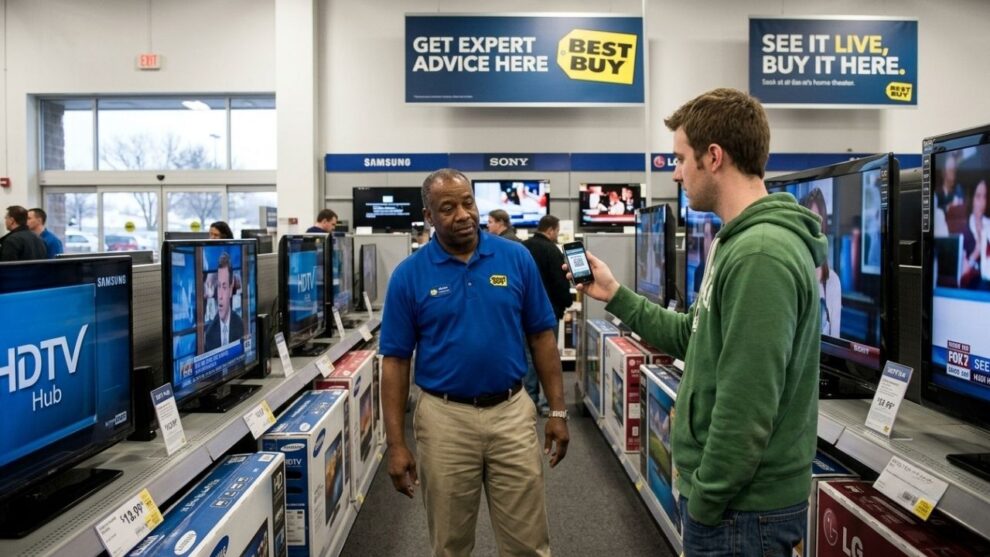
Amazon turned Best Buy’s stores into a free showroom. Customers tested TVs in the aisles, asked the blue shirts for advice, then bought the same television online for less. By the early 2010s, analysts and the press had written Best Buy’s obituary. The company survived, and its survival plan holds a direct lesson for car audio dealers and installers facing the same pressure today.
It started with a tornado. Best Buy’s founder Richard Schulze discovered the winning formula almost by accident. In 1981, a tornado destroyed his most profitable store in Roseville, Minnesota. Instead of simply rebuilding, he sold the surviving inventory out of the parking lot at steep discounts. The response was so strong it reshaped his entire strategy, and Best Buy was born two years later. The tornado revealed something important: customers would show up in huge numbers if the price was right and the selection was wide. That insight carried the company for decades, until the internet turned it into a liability.
The problem was never the price. Big ticket electronics carry thin margins, often in the 4 to 8 percent range, and price matching with online retailers squeezes that further. Best Buy’s leadership decided not to fight that battle. Instead of trying to out price Amazon, the company matched Amazon’s prices on hardware and stopped treating the sale of a television as the business. Car audio faces the same math. A subwoofer, amplifier, or head unit can be researched, compared, and bought online in minutes. A shop competing purely on price is fighting a battle it usually loses.
From one bicycle to a fleet of Beetles. In 1994, a college student named Robert Stephens started a computer repair business in Minneapolis. He called it Geek Squad. He rode to customers on a bicycle, carried his tools in a bag, and charged modest rates. The operation grew, and as it did, Stephens outfitted his technicians in matching uniforms and sent them out in black and white Volkswagen Beetles. The look was unmistakable. Best Buy bought Geek Squad in 2002 for about 3 million dollars. What looked like a quirky tech support company turned out to be the missing piece of Best Buy’s business model.
The real business was in the truck, not the box. Geek Squad installs, repairs, and services the products Best Buy sells. That service layer, along with protection plans, became the profit engine. One industry estimate put extended warranty margins at 50 to 60 percent, compared to 15 to 20 percent on typical retail products. For a car audio dealer, the equivalent is the install bay, the tune, and the calibration work. That labor cannot be shipped from a warehouse or matched by a marketplace listing. A customer can buy a DSP online for less than a local shop charges, but that customer still needs someone to integrate it, tune it, and stand behind the installation. That is where a shop keeps its margin and its customer relationship.
The lesson for car audio dealers is not to wait for a disaster to force the question. The pressure already exists in the form of online price comparison, DIY installation videos, and Facebook marketplace competition. Shops that treat installation, tuning, warranty support, and ongoing service as the actual product, rather than an add on to a sale, are the ones positioned to grow. The box gets price shopped. The person doing the work in the customer’s vehicle does not.
*this was inspired from a Facebook article, by Chris M. Walker



Words to live by in our industry. Well said.
Although I agree that installation should be the differentiator, not so sure Best Buy survived in car audio through Geek Squad profit, which has been known for loosing money (expenses related to bays and staff) but deemed necessary to maintain about half their sales.
They have closed many install bays using a hub and spoke model, trying to schedule installs from several stores at one. They evolved into a reoccurring subscription model that has been profitable company wide providing in home service to support any device, which at first included free car audio installation. Now Best Buy has recently increased all automotive installation fees and offers discounts on car audio installs for subscribed members. Best Buy has the luxury to adjust loses in car audio as a rounding error while they adjust to a more sustainable pricing strategy.
Independents often compete with themselves by not offering consistent quality of service and presentation, along with selection. The distributor channel is strong enough that an independent showroom can offer all types of upgrade products including truck accessories, window tint, and anything else installable they can think of. Having the premiere auto and truck upgrade showroom will make enthusiasts want to visit to dream what’s possible, fully installed and professionally integrated in their new-to-them vehicle.
Most consumers upgrade after making a used vehicle purchase (with over 40M used vehicle transactions per year, figure out how to get in front of your share of the market), then when they walk into your showroom, close them with your professional service, only quoting installed if possible.
You will never compete on price, but you can compete on selection using distribution, and professional service. You want to be more like True Value than Hone Depot, the designer showcase to cater to customers willing to spend the extra money for the expert recommendations and professional service.
Join MEA, become MECP certified, attend KnowledgeFest and highlight your education and experience as the recognized industry leader in your market.
Good luck to us all!