






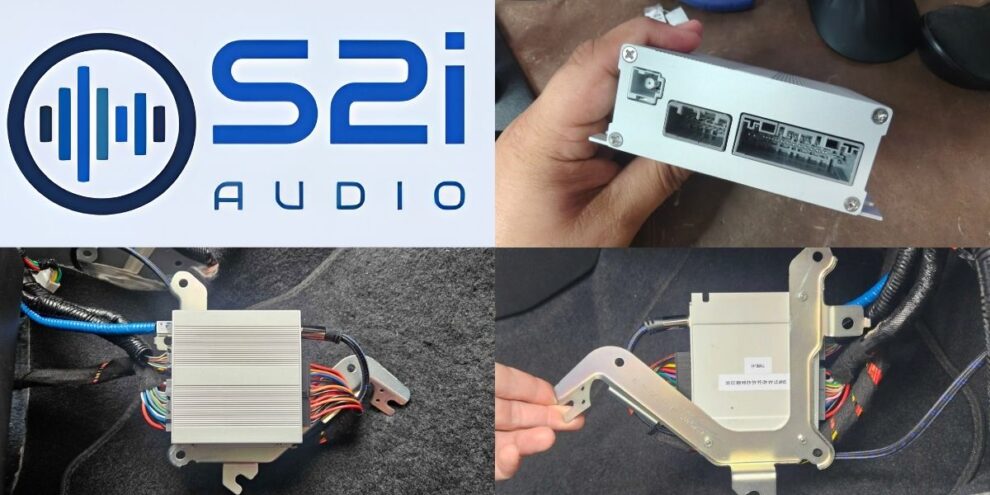
An independent engineer has built a device called Pure that decodes Honda’s proprietary factory audio signal and replaces the vehicle’s factory amplifier. Pure gives industry professionals and enthusiasts a way to add aftermarket amplifiers and digital signal processors without cutting a single factory wire. Honda’s factory signal limitations have made this kind of upgrade difficult in the past.
Ash Shabudin, founder of S2iAudio, started the project in February after buying a 2025 Acura Integra Type S and growing frustrated with the sound quality of its factory system. Shabudin said he did not want to rely on summing the vehicle’s analog outputs, because he could never be certain what the factory signal processing was doing to the audio. He wanted to work with an unprocessed digital signal instead.
That meant reverse engineering wiring Honda has not published anywhere, including one connector that does not appear in the manufacturer’s parts catalogs. It took months to identify the parts and figure out the protocol Honda uses to control volume, bass and EQ settings. Shabudin found a proprietary RS485 digital signal running in parallel with the audio stream, not a standard he could look up.
Pure replaces the factory amplifier by plugging directly into the factory wiring harness. It acts as an input and output hub, decoding the RS485 control signal and converting it into a format a digital signal processor can read. Pure also manages the digital audio output sent to a DSP. When paired with an aftermarket DSP, it serves as a complete replacement for the factory amplifier.
Installation does not require cutting any of the factory wiring, so Pure can be simply unplugged and the vehicle is returned to stock condition. This matters for leased vehicles and for markets outside North America, where regulations require factory systems to stay intact. Shabudin said one of his first customers installed the unit in Switzerland. “Not a single factory wire is altered with our unit,” Shabudin said. Installers who want to keep factory infotainment features like navigation prompts and voice calls should choose a DSP that supports signal ducking, so those inputs still take priority when active.
The version currently shipping controls volume by mimicking the analog remote input found on DSPs from brands such as Helix and Arc Audio. Shabudin has now finished a second generation that performs volume attenuation on Pure itself before the signal reaches the DSP. This change removes the need for an analog remote input. The updated device will work with any amplifier or DSP that has a TOSLink digital input, solving compatibility with brands that have moved to digital only volume control.
Pure has an MSRP of $350 for the Gen1 and $400 for Gen2 in the United States. Shabudin said the company plans to hold a fixed MSRP to protect dealer margin. Pure is already selling on S2iAudio’s website.
The product reflects a broader pattern in car audio, where smaller independent companies are solving specific vehicle compatibility problems faster than larger, established brands.
List of compatible vehicles:
- 2023 – 2026 Acura Integra, with ELS Audio only
- 2022 – 2025 Honda Civic (non-CTR), with Bose Audio only
- 2022 – 2026 Honda Civic Type-R, all trims
- 2016 – 2021 Honda Civic (incl. CTR), with Premium Audio only
- 2018 – 2022 Honda Accord, with Premium Audio only
- 2023 – 2025 Honda CR-V, with Bose Audio only
- 2017 – 2022 Honda CR-V, with Premium Audio only
- 2025 – 2026 Honda Odyssey, with Premium Audio only
- 2024 – 2026 Honda Ridgeline, with Premium Audio only
- 2023 – 2025 Honda Pilot, with Bose Audio only
*Signal ducking (often just called “ducking“) is an automated audio process that temporarily lowers the volume of one sound signal whenever a second, more important signal is present.
Get the news before your competitors do. CEoutlook is the daily brief read by over 6,500 dealers, reps and manufacturers across the mobile electronics industry. Subscribe free.



Ash @ S2i here – thanks for the coverage! It means a lot!
Huge applause! Great work – I love how the innovation continues to evolve in our world of aftermarket solutions.
Love this!
Fantastic!