





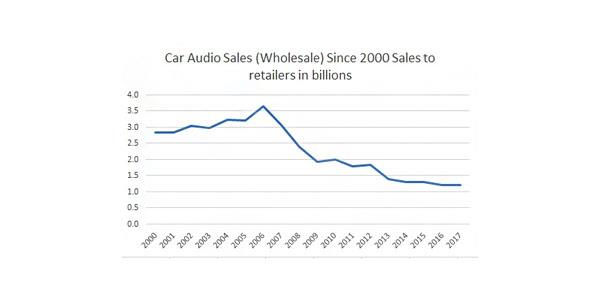
Here is a view of car audio sales since the year 2000.
But before you read on, it’s important to note that car audio has splintered into many new categories, many of which are not yet tracked by the Consumer Electronics Association (CEA), which has provided the figures below.
For example, the CEA just started tracking backup cameras, but it does not track remote start or window tinting or sound dampening materials or advanced driver safety products.
But CEA data is useful for tracking the more traditional car audio aftermarket and peripherals that include car audio, car security, radar detectors, mobile video, satellite radio, marine audio, OE integration devices, sound processors and more.
According to the CEA, aftermarket car audio sales during the past 15 years peaked in the year 2006 at a wholesale level of over $3.6 billion. But since then traditional audio sales have fell by more than half (see graph below the chart).
The following chart and graph include forecasts through 2017 for a full view of where the aftermarket has been and where it is heading, for traditional car audio.
The question for dealers and suppliers then, is have they expanded into non-traditional areas sufficiently to prop up sales?
Photo via MESA.

Get the news before your competitors do. CEoutlook is the daily brief read by over 6,500 dealers, reps and manufacturers across the mobile electronics industry. Subscribe free.



I’m looking for a ledge to jump from ! L.O.L.
If this is CEA data, then I think we are left to assume a few things:
1. this is US only (and whatever sales to US based distributors who export to other countries is included).
2. The peak in 2006 was attributable mostly to portable navigation devices. That has moved to phones and to factory installed navigation. Much of that business was done outside traditional car audio retail.
3. While it’s interesting and titillating to see such huge decline without any detail, for the vast majority of industry players poised for success, the information isn’t particularly useful. This is the kind of graph an MBA uses to determine that any investment in this category is a losing proposition.
4. This is also sell-out data from member companies who report to CEA. There are plenty of product providers who aren’t and don’t. Just look at the number of companies who show their wares on the show floor at CES. That will give you an idea of the relevance of the CEA in the aftermarket mobile business.
I agree that there are plenty of problems in the industry, but too much focus on this kind of data isn’t useful. Whether or not you’re going to be successful depends on whether there is a market for what you do. For a brick and mortar retailer, that market is mostly local. For a manufacturer, there’s a different kind of segmentation that will help to plot a course for future success.
It is sad and so unnecessary. The industry has so much to offer, but no one is willing to take the actions necessary to grow and secure it to consumers. Allowing it to sink on its own seems preferable to manufacturers and retailers alike.
Such incredible insight by CE Outlook. I am really glad they dug deep and put some serious effort into this eye opening report. Really changes the way I look at my business
Seriously?
Thanks for the comments Andy. FYI, this data does NOT contain portable nav. Anyway, as I said, it’s only part of the product mix that most car audio retailers sell.
Really? No portable Nav in that data? OK. My bad on point #2.
This meant to be wake-up call. The writing is on the wall – really really understand that people are using their smart phones for everything, its like they don’t care anything you put in the car – audio, navi, apps !
Wonder if the manufacturers are noticing the more online sales have grown the more overall sales have dropped. Just something to consider.
Way to tell us what we all already know. And depress us first thing in the morning. lol