





By Richard Truesdell
While some of the car introductions at CES were a snooze, Kia’s showed a concept that would truly transform trucks and vans as we know them.
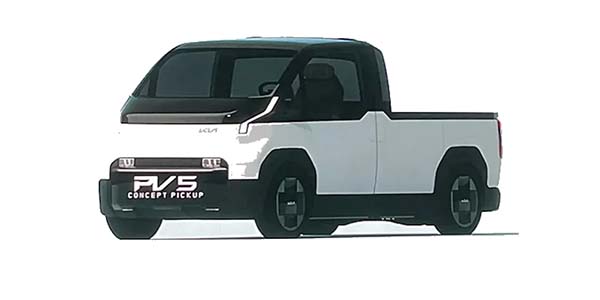
It introduced a series of modular concept vans where the back can be removed so the van becomes a pickup truck, for example.
It calls the concept Platform Beyond Vehicles or PBVs. As this video illustrates, except for the shared forward cab, Kia’s PBV offers almost unlimited custom possibilities. The platform can be transformed from a pickup into a cargo van, a tall-roof cargo van, a passenger minivan, and several other variations tailored for specific needs.
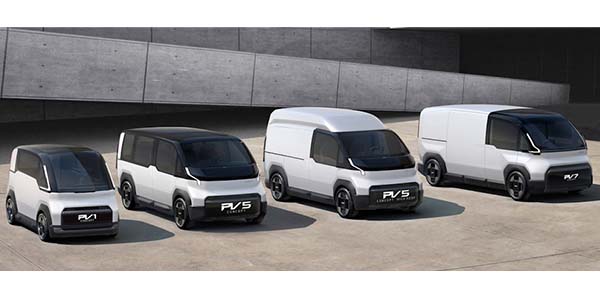
For its PBV range, Kia showed four vehicle concepts, the subcompact PV1, the compact PV5, and the mid-sized PV7. In watching the presentation, the emphasis was on the compact PV5. Kia CEO Hong So Song told The Drive that PV5 pickups could start at $35,000, which would make it a winner.
Especially innovative was Kia’s electro-mechanical system, dubbed the Hybrid Coupling Unit. This screws the various vehicle modules together. This could work for commercial applications but I think it’s a stretch to see this as viable in consumer/residential markets. Where would you store the back module when the PV5 is used as a pickup?
Less details were shared on the larger PV7 and PV9 models as well as the smaller PV1 model. Conspicuous by its absence was any mention of a PV3 model. If the range is based on the modularity of the PV5 as its foundation, could a PV3 be a lower-cost version of the PV5? This could be either a single-function minivan or could it be what’s missing–a dedicated compact crossover/SUV that lacks modularity, but squarely targets this important market segment as it exists today.
Kia implied that some versions of the PV5 will hit the market in 2025, likely as 2026 models. Knowing how long it takes to launch a platform, especially one that is new from the ground up, it’s my opinion that the first PV5 variant will reach the market in limited quantities no earlier than early 2026 as a 2027 model.
Takeaway: Kia’s PVP is an innovative concept. Its Lego-like modular approach offers customization well beyond anything currently available. Interestingly, Kia’s focus appears to be in van-like commercial vehicles from subcompact to full-size. I found its forward-control pickup especially interesting with its ability to transform into a completely different van configuration by installing a different module.
But all this versatility comes with a cost. Having covered the automotive industry for more than two decades, I have seen concepts that appear to make sense but never come to fruition in concept form. The cost of providing this OEM-level of customization that few buyers will take advantage of never makes financial sense.
For 12-volt retailers, opportunity, if there is any, is down the road—at least two to three years out—when there is an installed base of vehicles where creative retailers can take advantage of our proven ability to customize vehicles to meet specific needs, especially for fleet customers.
Get the news before your competitors do. CEoutlook is the daily brief read by over 6,500 dealers, reps and manufacturers across the mobile electronics industry. Subscribe free.



Toyota is also launching one (multi platform eco vehicle) this year in South Africa
In my haste to get this submitted quickly, I neglected to mention where the Kia PV5 in its planned van or tall-roof variants makes a lot of sense for 12-volt retailers, as a dual-purpose demo and/or delivery vehicle. The tall-roof version especially which looks tall enough to stand up in, is especially attractive.
It’s pretty tough to get excited about a new take on what amounts to a fresh take on what is inessence a minivan but the Kia PV5 does it for me.