







A response to David Wall’s “Are We Growing the Pie, or Just Fighting Over the Slices?”
By Bob Fields, Guest Writer
Editor’s Note: This is a longer read, about 7 minutes, but it is worth your time. Bob Fields draws on decades in the industry to show how the biggest aftermarket brands built factory business, and what that means for independent retailers deciding their next move.
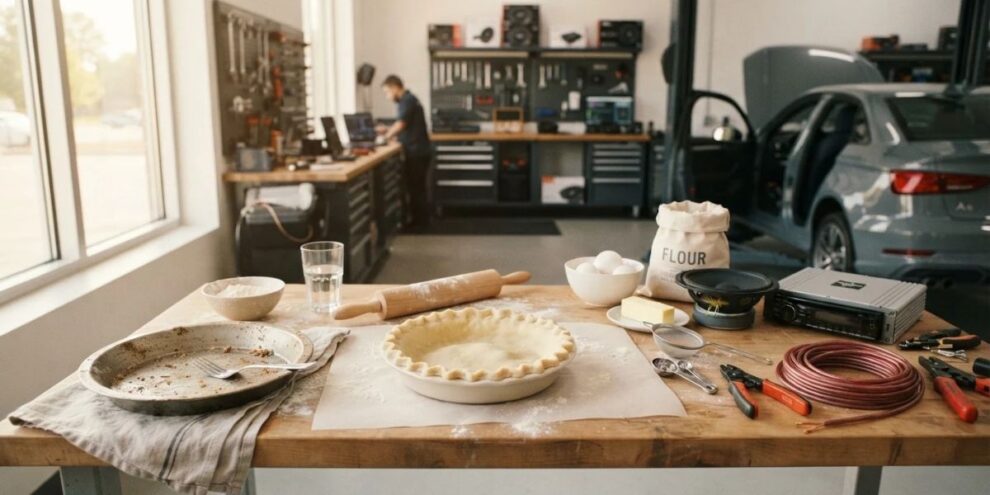
It’s past time to bake a new pie. The old one was eaten, and the ingredients for the next one have been in front of us for more than 30 years.
I had a front row seat as the mobile electronics industry changed. I worked with manufacturers, reps, and independent retailers, helping businesses adopt tools that could give them a better future. The foundations of today’s marketplace were taking shape then. Understanding how we got here can help us see where to go next.
The future of the specialist retailer is ours to shape. We have experience, technical capability, relationships, and resources that earlier generations could only imagine. The question is whether we will use them to build businesses for the customers and opportunities ahead of us.
The Manufacturers Were Already Building Their Next Business
Consider the breadth of the companies that developed business with automakers while maintaining an aftermarket presence.
Pioneer built substantial OEM operations alongside its familiar retail products. [1] Alpine developed factory audio and navigation relationships. [2] Clarion supplied automaker systems while remaining a major aftermarket name. [3] Panasonic served both markets. [4] Sony brought branded audio to Ford. [5] Kenwood, now within JVCKENWOOD, developed an OEM business alongside its retail business. [6] Blaupunkt participated in both channels during its Bosch years, before those operations were separated. [7]
Eclipse was the aftermarket face of Fujitsu Ten, now Denso Ten, whose automotive supply relationships included Toyota. [8] Nakamichi brought its premium audio reputation into Lexus vehicles. [9] Rockford Fosgate supplied products or licensed its brand and technology for Nissan and Mitsubishi factory systems. [10] Boston Acoustics entered factory audio through a partnership with Visteon for Chrysler. [11]
JBL and Infinity developed significant automotive business through Harman while remaining familiar names on retailers’ shelves. [12, 13] Focal later expanded from specialist aftermarket products into factory audio, including its Peugeot partnership. [14] Kicker supplied genuine Subaru audio accessories, another route into automaker business. [15] In security and convenience, Code Alarm and Audiovox developed OEM and automaker accessory relationships while selling through independent retailers. [16, 17]
These relationships were not identical. Factory supply, component sales, brand licensing, and automaker approved accessories are different businesses. Nor does a historical program mean that every relationship continues today. But the breadth is unmistakable. This was a direction pursued by many of the names that helped define our industry.
Pioneer’s disclosures provide a useful measure: OEM sales accounted for 35 percent of its Car Electronics business in fiscal 2006 and 57 percent in fiscal 2015. [18, 19] Those figures describe Pioneer’s revenue mix, not its share of the automotive market. They show how deeply an aftermarket household name had developed another channel.
Think about how many of those brands have appeared in your showroom. Their pursuit of automotive business was already helping shape the marketplace we face today.
Understand the Economics and Take Control
A relatively small team serving a few automaker accounts can generate tens of millions of dollars in revenue. Producing comparable sales through thousands of independent retailers requires a much larger sales, distribution, training, and support organization.
OEM business has development costs, demanding requirements, and financial risks. Pioneer’s experience demonstrates that large contracts do not automatically mean healthy profits. [20] Nevertheless, the attraction is understandable.
Manufacturers were pursuing opportunities they believed could strengthen their businesses. Retailers have the same responsibility to pursue opportunities that strengthen theirs.
That starts with accepting that the marketplace will keep moving. Technology, vehicles, consumers, and supplier strategies will change. An independent business has the freedom to respond, reposition, and choose its partners. That freedom is an advantage when an owner uses it.
If a supplier continually makes you pull your hair out, address the relationship. If it cannot become productive, make a different choice. You have a say in the partners you keep. Use that freedom to build relationships that support the business you want to lead.
Doing the same thing repeatedly and expecting a different result will not move us forward. Neither will waiting for someone else to improve our businesses. The next chapter starts with the choices we make.
“Sell your business as the brand, rather than leading with the products you carry.”
We Recognized the Need to Adapt Decades Ago
KnowledgeFest’s origins tell an encouraging story about what this industry can accomplish.
The Mobile Electronics Association traces its beginnings to meetings organized by Randy Strunk of Creative Sales & Marketing in 1992. Joe Cavanaugh of Stereo West shared ideas and experience that helped other retailers improve. Those exchanges grew into the first KnowledgeFest in 1994 at Missouri’s Lake of the Ozarks. [21]
Successful retailers and reps were willing to share their knowledge with others. They recognized challenges and did something about them. That commitment helped create an enduring educational resource focused on mobile electronics specialists.
The lesson I took from those efforts remains relevant: think like a business owner, operate with integrity, understand your market, and focus on work that makes you money.
Today, my friend Chris Cook carries that commitment forward as Mobile Electronics Association (MEA) president. You will find no one more passionate about the mobile electronics business. Across the industry’s different sectors, he has done more, for longer, than anyone else I know. He is a man of integrity, passion, and commitment.
People like Chris remind me how much this industry still has going for it. There are people who care, knowledge worth sharing, and businesses worth building. Engage with them. Bring your ambition and your questions. Contribute what you know and be willing to learn something new.
I Have Seen What Investing in Your Business Can Do
Some readers may not know me because I have been out of active participation in mobile electronics for about 20 years. As vice president of sales and operations at Sound Solutions, the creators of TSS, I worked with Tony Frangiosa to grow our dealer base from fewer than 200 TSS users to more than 2,500.
I also made the decision and pushed Tony to bring Tim Armstrong into the company. Tim eventually became chief architect of TSS. Bringing capable people together around a real business need was part of how we helped retailers move forward. There are many other names that could and should be recognized that have contributed significantly to what we now know as InstallerNet.
That work reached many businesses. We were helping independent operators make better decisions at a time when affordable business management systems were far less common.
One frustration from those days still exists: retailers investing in software and then using it as a glorified cash register. The potential is there, but it takes an owner’s commitment to turn capability into progress.
Today, dealers have software options. There is no excuse for operating without a clear understanding of your business. If cost is holding you back, that concern is exactly why you need it. Make an investment you can sustain, then commit to learning and using it.
Choose a system you can afford, learn it, and use it. If you have TSS, pursue the training that helps you get more from your investment. Explore Richard Basler Consulting or another qualified resource. Seek out the InstallerNet team with your questions. Treat education as part of building your future.
Sell Your Business as the Brand
Sell your business as the brand, rather than leading with the products you carry.
The products you carry support your promise. Your knowledge, judgment, craftsmanship, and integrity give customers a reason to choose you. Those qualities belong to your business regardless of which logo appears on a box.
A supplier can change distribution. A product can become available somewhere else. Your reputation is something you build through the work you do and the trust you earn.
Give customers a reason to seek out your team. Help them understand what you can make possible in their vehicles. Become known for solving problems and delivering experiences they value. Build a business whose name carries meaning in your community.
That position gives you room to evolve. As customer needs change, your expertise can guide them toward new possibilities. Your business becomes the relationship they return to.
The Future Deserves Our Attention
I heard predictions that car audio and independent retailers were finished more than 20 years ago. Many brands, including some mentioned here, were debating that very issue. Clearly, that has not happened. There are still businesses creating value, adapting, and earning customers’ trust.
The next opportunity starts with understanding the world around your store. Study the economics and demographics of your area. Learn what people need, what they value, and where your capabilities can meet that demand. Let your passion inspire you and let that understanding guide your decisions.
You must explore how you can recognize emerging opportunities, build a stronger identity in your market, and turn knowledge into growth. This is the foundation: understand the change, take ownership of your direction, and give customers a compelling reason to choose your business.
The future can be bright. You have experience to build on and the ability to learn what comes next. Start by looking at your marketplace with fresh eyes, then decide where your business can create the greatest value.
It’s past time to bake a new pie.
—
About the Writer
Bob Fields is a longtime industry veteran and an active leader in the Consumer Technology Association (CTA). He is a former VP of Teaming and Strategic Alliances at MiTek and a former CEO of Victory Technologies, which made car audio fit guides. He serves on the CTA Board of Industry Leaders. He can be reached through Beacon Technology Group.
Sources
Numbers in the article identify the sources for each manufacturer claim. Company disclosures and filings are primary sources unless identified as industry reporting. Historical examples do not establish current contracts or current market share.
[1] Pioneer: The Hansen Report on Automotive Electronics, September 2003, company profile, pages 4 to 6. Contemporary reporting documents both aftermarket operations and OEM programs.
[2] Alpine: Official Alps Alpine corporate history documents Lamborghini OEM radio adoption and navigation development with Honda. Alpine’s UK company overview describes both OEM and aftermarket operations and identifies European OEM customers.
[3] Clarion: Official 2013 Business Outline discusses OEM genuine parts relationships and Nissan LEAF navigation. Clarion’s company issued 75th anniversary release, February 2015, describes its OEM and aftermarket activities.
[4] Panasonic: Official automotive history documents first automaker radio supply to Isuzu in 1954 and first automaker navigation supply in 1992. A Panasonic press release reproduced by HEXUS describes its 2006 retail in car AV lineup.
[5] Sony: Official release, May 26, 2004, announcing Sony branded factory audio for Ford Focus and describing its first such installation in North America.
[6] Kenwood / JVCKENWOOD: Official Business Outline separately describes OEM supply to automobile manufacturers and aftermarket supply to retailers and distributors. Evidence is at group level; it should not be read as identifying a particular branded Kenwood factory contract.
[7] Blaupunkt: TWICE industry reporting, December 18, 2008, explains Bosch’s sale of the aftermarket and audio components business while retaining OEM car electronics.
[8] Eclipse / Fujitsu Ten: Official November 12, 2008 release describes Eclipse as Fujitsu Ten’s aftermarket brand and identifies genuine product supply to Toyota and other automakers. Denso Ten’s official history documents the later corporate name change.
[9] Nakamichi: Lexus 1998 GS owner’s manual identifies factory Nakamichi audio; Nakamichi USA’s brand history describes Toyota selecting Nakamichi for Lexus audio.
[10] Rockford Fosgate: Rockford Corporation fiscal 2008 Form 10-K, filed in 2009, documents aftermarket products and product sales or brand and technology licensing for Nissan and Mitsubishi OEM systems.
[11] Boston Acoustics: Company release, November 23, 2004, reproduced by The Auto Channel, identifies entry into automotive OEM through Visteon for Chrysler 300. Its October 2008 SEMA release describes aftermarket and OEM activities.
[12] JBL: Toyota USA Newsroom, “Perfect Harmony,” December 2022, identifies the U.S. Camry launch in 1998. Harman’s retail site documents JBL and Infinity aftermarket component systems.
[13] Infinity: Chrysler 1987 service bulletin, “Infinity Speaker System: Introduction”, archived by Operation CHARM, describes jointly developed systems for New Yorker, LeBaron GTS, and Dodge Lancer. Harman’s official 2016 release documents Infinity Reference aftermarket speakers and amplifiers.
[14] Focal: Official Peugeot partnership history (French version) explicitly describes its transition from aftermarket car audio into OEM and production vehicle collaboration in 2016.
[15] Kicker: Subaru’s official genuine accessory listing identifies its powered subwoofer as manufactured for Subaru of America by Kicker. This proves automaker accessory supply, not assembly line installation.
[16] Code Alarm: TWICE industry reporting, “Audiovox Completes Code Alarm,” 2002, identifies OEM customers and Ford dealer security, keyless entry, and remote start programs.
[17] Audiovox: Fiscal 2009 Form 10-K documents retail brands and OEM arrangements with automakers. Disclosures encompass multiple product categories and should not be assigned to individual security brands without further evidence.
[18] Pioneer OEM sales mix: Fiscal 2006 Form 20-F, Car Electronics business description: 35 percent of segment sales on an OEM basis.
[19] Pioneer OEM sales mix: Fiscal 2015 business results, May 12, 2015, page 2: 57 percent of Car Electronics sales, compared with 54 percent in fiscal 2014.
[20] Pioneer OEM profitability: Fiscal 2018 annual results Q&A, May 14, 2018, reports delayed profitability improvements due to development investment for large scale orders.
[21] KnowledgeFest origins: Mobile Electronics Association official history identifies Randy Strunk, Creative Sales & Marketing, Joe Cavanaugh, the initial 1992 meetings, and the first KnowledgeFest in 1994.
Get the news before your competitors do. CEoutlook is the daily brief read by over 6,500 dealers, reps and manufacturers across the mobile electronics industry.



I read the article expecting to hear some new ideas about how we could grow the overall market. Instead, I found a history of how manufacturers pursued OEM opportunities and familiar advice about training, business management and building our own retail brands.
I agree with much of that advice. We’ve been practicing those principles at Freeman’s for years.
But that’s not the question I was asking.
My question is what we’re doing to introduce new consumers to our industry. Who is creating the next generation of car-audio enthusiasts?
We can continue investing in ourselves, improving our operations and becoming better at competing for existing customers. Those are important things.
But where is the investment in creating customers who don’t exist yet?
If we’re going to bake a new pie, shouldn’t we start by talking about how to create more demand rather than simply becoming better at dividing the demand we already have?
Completely agree