






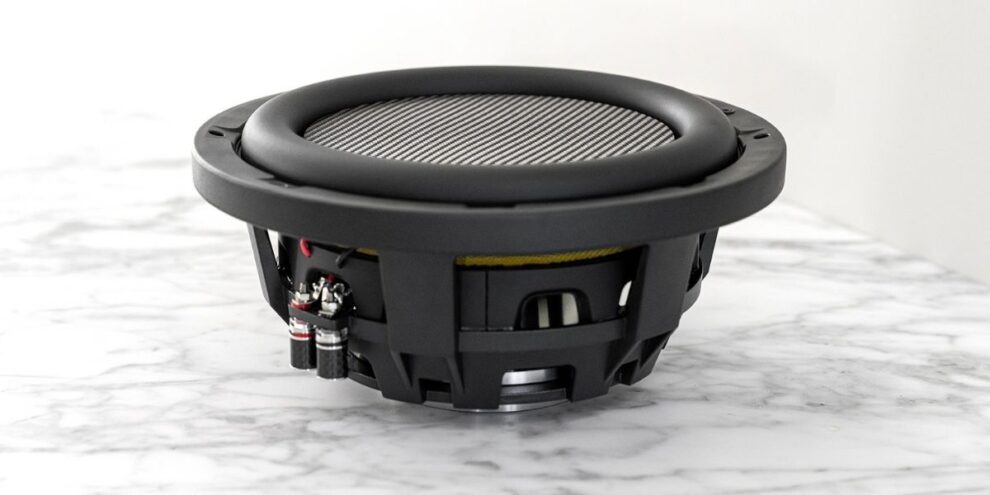
Guest Post: Nick Apicella Introduces His New Line of Subwoofers
ResoNix Sound Solutions is expanding its dealer program with the launch of its new GUS shallow subwoofer line, a series of 10, 12 and 15-inch high-performance subwoofers developed specifically for small sealed enclosures and shallow installations. Dealers can begin working with ResoNix on the GUS line now, alongside the company’s existing premium automotive sound treatment products. Dealers interested in carrying ResoNix can contact the company directly here.
The GUS line has already generated more than 600 preorders, with most of the initial production run spoken for before customer shipments began. Additional production is expected to be available in October as ResoNix begins a larger push to expand its brick-and-mortar dealer network.
Retail pricing is $850 for the GUS-10, $999 for the GUS-12 and $1,299 for the GUS-15. Recommended 0.707-Qtc sealed volumes are approximately 0.5, 0.75 and 1.4 cubic feet respectively, with mounting depths of just 4.0, 4.54 and 5.81 inches.
The goal behind GUS was to combine several characteristics that ResoNix founder Nick Apicella says were difficult to find in a single high-end car audio subwoofer: very small sealed enclosure requirements, shallow mounting depth, substantial and verified linear excursion, very low distortion, and strong low-frequency extension.
Linear one-way Xmax is rated at 18 mm for the GUS-10, 20 mm for the GUS-12 and 25 mm for the GUS-15, as verified through Klippel testing. ResoNix also publishes the BL curve, along with suspension compliance and inductance behavior, demonstrating that these parameters remain controlled throughout the rated excursion rather than becoming practical limitations before the advertised Xmax is reached, something never publicly documented to this extent in the car audio industry.
Another installation-focused feature allows the rear pole vent to be completely obstructed when the installation requires it. Additional venting through the voice-coil former and rear cone assembly allows the subwoofer to operate with no measurable or audible change in behavior, eliminating the additional rear clearance normally required for a pole-vented driver. While GUS development was getting underway, Apicella began the ResoNix Klippel subwoofer testing project to establish objective benchmarks for several of his personal reference subwoofers and better understand the performance landscape GUS would need to compete with. The project eventually expanded into a broader look at the car audio subwoofer market, and ResoNix decided to make the results public to help educate enthusiasts about the products they were purchasing. Approximately 50 subwoofers have now been tested, with total expenses exceeding $35,000, not including Apicella’s own time.
Klippel testing allows engineers to measure how a loudspeaker’s motor, suspension and inductance behave throughout its excursion, along with output and distortion, providing a more complete picture of real-world large-signal performance than conventional specifications alone.
The published Klippel testing results showed significant differences between advertised specifications and the performance of many tested samples. One shallow subwoofer advertised with 20 mm of one-way Xmax reached the standard 70-percent BL threshold at only 8.85 mm, about 44 percent of the advertised figure. Another advertised at 28 mm measured 17.46 mm following the same standardized criteria, while inductance became a limiting factor even earlier. Another sample triggered the Klippel system’s voice-coil thermal protection at approximately half of its published RMS power rating. ResoNix publishes the individual measurements, methodology and caveats directly through its independent subwoofer testing.
Those measurements became useful benchmarks during GUS development. GUS, named after Apicella’s cat Gustavo, also stands for “Geometrically Uncompromised Subwoofer.” The name reflects the design goal of maintaining motor geometry and linear excursion without giving up the packaging advantages associated with shallow subwoofers.
Other design features include an FEA-optimized overhung motor, a patent-pending full-length copper and aluminum shorting sleeve to reduce inductance modulation and distortion, and a Nomex honeycomb and carbon-fiber flat cone intended to maintain rigidity at high excursion. ResoNix says the combination was developed to achieve very low distortion and ultra-low-frequency extension while retaining substantial displacement capability in small sealed enclosures and at relatively shallow mounting depths.
GUS prototype and production models have also been subjected to the same Klippel LSI and distortion measurements used in the broader ResoNix testing project, with results published alongside the competing drivers. Apicella says production units will continue to be measured as time goes on so customers can compare finished products against the original development targets.
Apicella founded ResoNix Sound Solutions in 2019 out of frustration with the lack of high-quality sound deadening products available at the time. ResoNix initially focused on automotive sound treatment, developing its own constrained-layer sound deadener, sound absorption, and other high-end automotive noise-control products.
For ResoNix, GUS represents an expansion rather than a change in direction. Automotive sound treatment remains the company’s core product category, while GUS, born out of a similar frustration, marks the beginning of a broader ResoNix loudspeaker lineup and a larger push into the brick-and-mortar dealer market, with additional subwoofer designs already in development.


