





By Mr Retail
I was honored to teach one of the business classes at this year’s MasterTech Expo. If you haven’t made it to one of these events, I highly suggest finding the time, as it truly offers world class education packed into four days at a very reasonable price. My class was designed to get you to really dig into the profitability in your installation department. So, let’s dig into it.
We begin by helping you see that you must track the efficiency of each installer. Here is an example: if you are open five days per week and eight hours per day, I would say you need to average 80 percent efficiency over the course of the year. This allows for paid time off, sick days, lunch, potty breaks, etc. ALL of these items are important in order to find your efficiency percentage.
Next up, you need to see how to improve efficiency. If you open at 9 am, is the tech grabbing the keys and off to the races with the first vehicle? Or are they tracking down product, having to ask lots of questions about the job, and not really getting into it for let’s say 20 minutes? Do that five times per week and you lose 100 minutes, or 1.66 hours of labor. If you bill $120 an hour, that is $200 in labor you could have billed. Have two techs? That is $20,800 per year in just one example.
Could a salesperson or lower paid employee help get product or vehicles into and out of the bay so the tech could spend more time installing? How much extra money would that make you?
Consider how hard it is to find good technicians. If you can increase their efficiency by 20 percent over an average week, you make more, they make more, and they are happier. We all know their favorite place is buried in the car or the fab shop. So maximize it.
Now, assuming you don’t have enough hours in the day to do all your work because of tech shortages, you need to consider eliminating lower profit dollar categories and maximizing higher profit dollar jobs. Here’s an example:
A truck bed cover costs $750 and sells for $1,000 for $25o in profit, but only 25 percent in margin.
A $200 component set costs you $67 for a 67 percent margin and $133 profit dollars. It should take two hours to install on an easy vehicle. So the bed cover nets you $250 in product profit per hour and the speakers net you $66.50 in profit dollars per hour in that exact same bay. I don’t know about you, but I’ll take the bed cover all day long.
Now, this isn’t an article designed to tell you to sell more bed covers. But it IS an article to help you rethink if you need to sell $80 coaxes, $200 separates, and $200 amplifiers. What I am getting at here is you likely can do just fine by eliminating less profitable dollar-per-hour categories to free you up to do more profitable ones. If a product costs you $80 and you sell it for $200 and it ties up your bay for four hours, stop selling it! You are losing money. And that brings me to the last point.
If you are a profitable business and claim ALL your expenses, then 15 percent is a healthy bottom line profit. For most businesses, selling 60 percent product and 40 percent labor is an average mix. And if your product margin is 50 percent, you double your money on your product categories as a whole, then on average, 30 percent of your net profit comes from the product you sell: (60 percent in product sales at 50 percent margin = 30 percent net).
Now remove the product profit and explain to me how you are making money on labor only jobs. The math doesn’t work. Plain and simple. Disagree with me all you like, but your accountant agrees with me. I do have one exception to this rule. If my install bay ever gets slow, we will take client-supplied work. While we are losing money, it is less than if my techs just stood around.
In closing, run these numbers and I think many of you will get indigestion. The good news is that by changing some things in your store, the sales team, installer, and you will all make more money, be happier, and be around a decade from now. I wish you well.
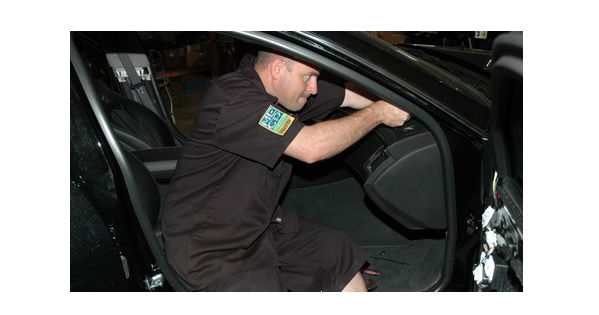
Photo credit: MECP
Mark Miller
(Mr Retail)

Mark is the CEO of Westminster Speed & Sound, an award-winning retailer in Westminster, Maryland. The company was founded in 1969, and Mark took it over in 1990 at the age of 23. He first started in the industry in 1986, so he has been at it for a while. He has served on the board of MERA, taught seminars in over a dozen different cities, and served on the SEMA New Product Awards judging team. He has been married to his wife Dawn for 33 years now and has four grown children and four grandchildren. His hobbies include being a sound engineer, doing life coaching, and being active in the local and national Porsche community.
Get the news before your competitors do. CEoutlook is the daily brief read by over 6,500 dealers, reps and manufacturers across the mobile electronics industry. Subscribe free.



Great read!
Ben, you are only factoring in labor profit in your equation. If the install takes 2 hours, you are making $66.50 per hour of labor in parts profit as well. My goal is to try and keep install part profit of at least $100 per hour plus the labor profit. And thanks for the feedback.
if you’re charging $120 hour labor rate & comp sets retail $200 (DC $67) most shops with install will be $320 looking at $165 per hour then pay your installer $40 hr now you make $125 per hour. Not every shop does truck accesories they just don’t have the right techs in general to do this. Lot of shops hope for cash & Carry where if consumer messes up it takes the burden off them & consumer must deal directly with car audio Manufacture but this has been getting worse where they don’t want to warranty anything from anybody even Dist are having hard time getting warranties in general.Definetily dealers do need to figure out how to be more profitable I do see that a lot at dealer level where it takes them up to 1/2 hour before they even start the project
You brought up some very important points Mark!